Naive Gaussian Elimination relies on equations of the form:
$$a_{11} x_{1} + a_{12} x_{2} + \cdots + a_{1n} x_{n} = b_{1}$$ $$a_{21} x_{1} + a_{22} x_{2} + \cdots + a_{2n} x_{n} = b_{2}$$ $$\vdots$$ $$a_{n1} x_{1} + a_{n2} x_{2} + \cdots + a_{nn} x_{n} = b_{n}$$
We actually solve systems like this all the time. We can do with qualitatively here too. If you remember in high school you got systems of equations that looked like
$$ax + by = m$$ $$cx + dy = n$$
Where $a, b, c, d, m, n$ are usually integers? You can actually do alot with just that, and you can sometimes find the solution to equations just by looking at the graph of them. Of course, sometimes you may want to but the equations into $y = mx + b$ for to make your life easier. Let's try it for 2 equations:
$$4x + y = 2$$ $$x - y = 3$$
Putting these equations into slope intercept form, we have:
$$y = -4x + 2$$ $$y = x - 3$$
Try and put these into the grapher below to get a vague idea of where the solution lies (i.e., the x and y coordinate of where the lines cross is the solution)
This is very helpful when trying to find the answer to problems such as when do two things meet up, assuming they travel at different speeds and starting positions.
The only issue is that this sort of really only works for this kind of problem. Like ok i guess you can do it for 3 Dimensions with Desmos' 3D calculator. Heres an example of the solution to
$$2x + 3y + z = 1$$ $$6x - 2y - z = -14$$ $$3x + y - z = 1$$
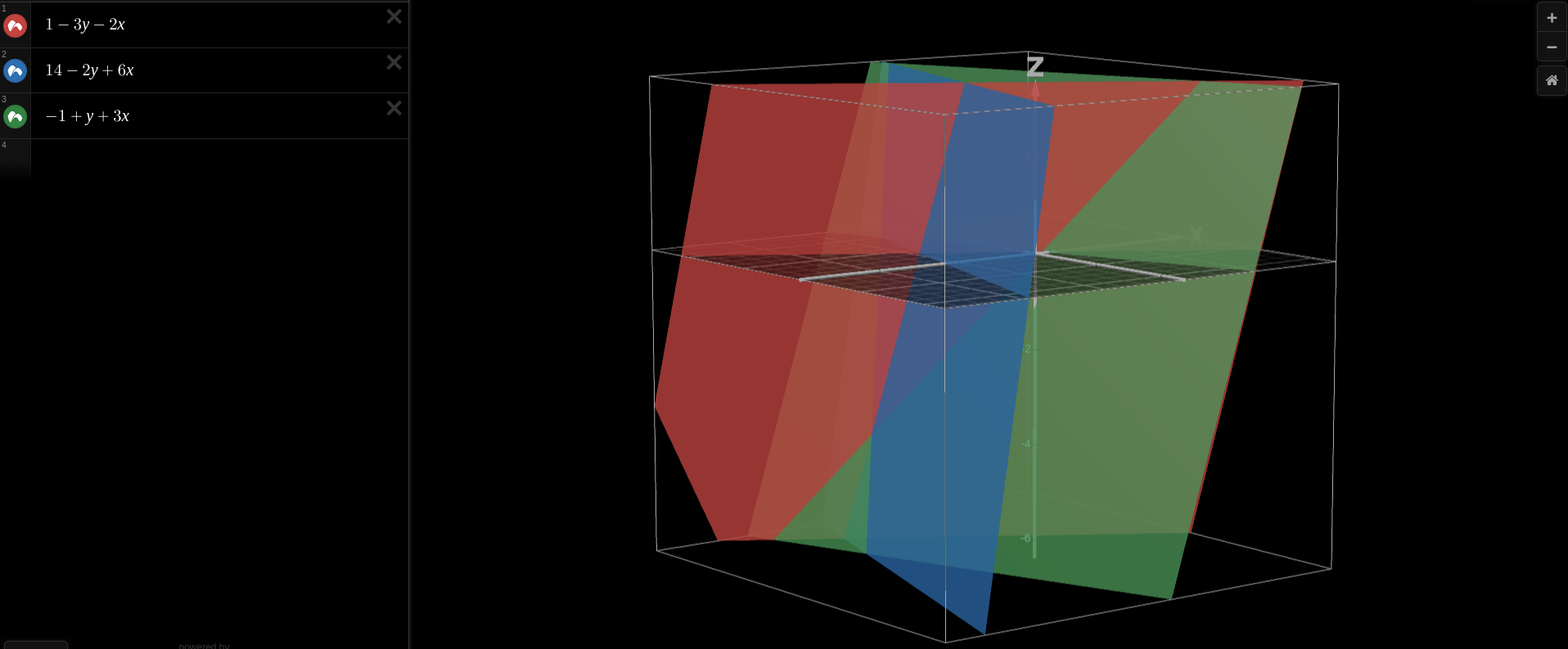
This sort of gets harder and harder to see every time. You can vaguely make out the point as $(x, y, z) = (-2, 3, -4)$, as where all of the planes intersect. It'll definetly get harder with more than 3 Dimensions, since we like live in 3 dimensional space.